


Page 38 - VHSA - Onderstepoort 100 Years - Part 1
P. 38
OND
ERSTEPOORT 100
of specialists on the post-graduate training of veterinarians in tropical veterinary medicine and animal husbandry, jointly arranged by the International Scientific Council for Africa south of the Sahara (CSA) and IBAH, as an observer.
As R.M. du Toit, then Dean of the Onderstepoort Faculty, was also going to attend in his capacity as a member of the United Nation’s Food and Agricultural Organization (FAO) expert panel on veterinary educa-
tion, Jansen decided not to attend. As
mentioned above, he negotiated re-
sumption of South Africa’s membership of
the OIE in Paris in 1961 with the govern-
ment.
assigned to the Institute. A letter was then sent to Jansen to suggest establishing a mission at Onderstepoort, to which Jansen agreed. J.D. Smit was to arrange McCully’s placing at Onderstepoort. McCully arrived in 1963 and was placed in the Pathology Section led by Smit where an extremely productive research partnership developed, particularly with P.A. Basson and, to a lesser extent, S.P. Kruger on the diseases
and parasites of wildlife in the Kruger National Park. W.O. Neitz and R.D. Bigalke of the Protozoology Section were other Onderstepoort researchers who worked closely with Bob McCully at some stage. This exchange programme, which is dis- cussed in more detail in Part 3: Pathology, lasted for almost 25 years and involved reciprocal visits by seven AFIP and three Onderstepoort pathologists.
Jansen was the first director of Onderstepoort to delegate the function of editing the ‘Onderstepoort Journal’ – the scientific mouthpiece of the Institute which has had various titles since it was initiated with Theiler’s ‘Reports of the Director of Veterinary Research’ and is currently known
as the ‘Onderstepoort Journal of Veterinary Research’ – to someone else at his Institute, in his case to Neitz.
A particularly noteworthy organizational milestone, which occurred during his regime as Director of Veterinary Services, was the transformation of the Division of Veterinary Field Services into the Directorate of Veterinary Services in 1962.
However, the situation regarding
Onderstepoort’s scientific isolation would
only get worse as time progressed until
it eventually all changed in 1994 when
the government’s apartheid policy was
abolished. A noteworthy exception, at least
in the 1960s, 1970s and early 1980s, was
the co-operation between Onderstepoort
and the Armed Forces Institute of Patholo-
gy (AFIP) in Washington DC. The AFIP had
a worldwide geographic pathology pro-
gramme, which included Africa, of several years standing to learn about diseases, especially those of humans. The initiative for the Onderstepoort programme was taken by the then Captain R.M. (Bob) McCully, an American veterinary pathologist working for the AFIP, who managed to convince Colonel Townsend, his director at the AFIP, that he should be
“However, the situation regarding Onderstpoort’s scientific isolation would only get worse as time progressed until it eventually all changed in 1994 when the government’s apartheid policy was abolished.”
38
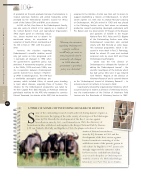
Some of the outstanding research results achieved during Jansen’s regime as Director were the typing of the wide variety of serotypes of the bluetongue virus by P.G. Howell; the development of the Rev-1 vaccine against brucellosis in rams by G.C. van Drimmelen in 1963; the discovery of besnoitosis in blue wildebeest and impala in the Kruger National Park by Basson, J.W. van Niekerk, McCully and Bigalke in 1965; the plaque-selection of vaccine
strains of African horsesickness
virus by B.J. Erasmus in 1965 and the development of the first vaccine against bovine besnoitiosis consisting of a blue wildebeest strain of the parasite grown in cell culture by Bigalke in 1967. Jansen also strongly supported the initiatives taken
by Verwoerd to establish biotechnology
as a research discipline at Onderstepoort with the creation of a Molecular Biology laboratory (see Part 3 for more details).
PART 1
Onderstepoort Veterinary Institute: General History
1908-2008
Years


