


Page 46 - VHSA - Onderstepoort 100 Years - Part 1
P. 46
OND
ERSTEPOORT 100
46
our knowledge on the epidemiology and immunology of the disease.
bile ducts thereby leading to the retention of phylloerythrin and photosensitivity, the latter being one of the pathognomonic clinical signs of geeldikkop. Exactly why microliths are produced had to await further investigations.
J.A. (Jan) Van Wyk’s studies on the in- fectivity and development of L3 larvae of Haemonchus contortus (wireworm), Tri- chostrongylus colubriformis and T. axei, which were stored in the frozen state for many years – some for more than 15 years – showed that cryo-preservation in liquid nitrogen is an excellent method of maintain- ing nematode larvae. It is far superior to the laborious and expensive method of cycling worm strains through their final hosts.
Good progress was made with studies on the epidemiology of foot and mouth disease (FMD). That the disease is endemic
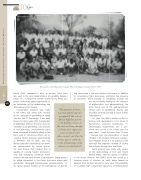
Participants in the Heartwater Congress held in the Kruger National Park in 1986
Kümm strain, passaged in mice, as antigen. Mice were also used in the early demonstration of variability between strains of E. ruminantium. Further studies by Du Plessis and various co-workers added significantly to
kop cases using a scanning electron microscope in addition to conventional light microscopy confirmed the presence of microliths, which partially or completely occlude the
Considerable progress was made
in the 1980s and 1990s with research
on the aetiology of geeldikkop in sheep
(see also Part 3: Toxicology). It has been
known for many years that consumption
of dubbeltjies (Tribulus terrestris) does not
invariably cause geeldikkop, vast amounts
of this nutritious, semi-perennial plant
being consumed annually by sheep in the
Karoo with no deleterious effects. An in-
teresting theory pursued experimentally
by Kellerman and his team, was that
during outbreaks of geeldikkop, the plants
are contaminated by fungal spores.
The only fungus they isolated that is
capable of causing hepatic photosensi-
tivity was Pithomyces chartarum which
contains the mycotoxin known as sporidesmin. Sheep grazing on wilted dubbeltjies in the Karoo that were dosed with sporidesmin developed hepatogenous photosensitivity, i.e. the typical disease. Studies on the pathogenesis of geeldik-
in the Kruger National Park (KNP), which has served as a festering source of infection for cattle being farmed on adjacent land, has been known for many years. The availability of a suitable, high containment laboratory at Onderstepoort
“The question, however, was: how did the impalas get infected? The role of African buffaloes, known to be healthy carriers of the virus and long thought to be the most important source of infection for other animals and thus the source of new outbreaks, in the epidemiology of the disease was investigated.”
PART 1
Onderstepoort Veterinary Institute: General History
1908-2008
Years


