


Page 52 - VHSA - Onderstepoort 100 Years - Part 1
P. 52
ONDERSTEPOORT 100
animal diseases in southern Africa, was highly successful and led to the appointment of a continuation committee tasked to survey the diagnostic capabilities of the SADC (Southern African Development Community) countries as well as their training facilities. The proposed creation
of a diagnostic network funded through
SADC unfortunately did not materialize. 52 Finally, a conference and workshop on the control of ticks and tick-borne diseases led to the establishment of a close relationship with an FAO programme with the same aim and negotiations about the possible provision of vaccines for this programme. A tender submitted to this effect was,
however, not accepted.
More positive results flowed from a well-
attended workshop on orbivirus research. A
substantial grant was obtained by A.A.
van Dijk from USAID which supported
collaborative work for a number of years.
Researchers at Onderstepoort were also
successful in three out of five applications for
long-term grants from the European Union,
reflecting recognition of their expertise in
the areas concerned. The financial support thus obtained was sufficient to balance out the declining baseline funding for some time. Although funding for capital expenditure and running costs was limited, an extensive programme for the upgrading of the ARC-OVI made good progress. All the main buildings and roads were renovated and external funding
increased to 26% of the total income for the 1996/97 year. The last two years under Verwoerd’s leadership saw further expansion of the diagnostic services to include a natio- nal surveillance programme for the National Department of Agriculture to confirm the absence of bovine spongiform encephalopathy (BSE or ‘mad cow disease’) in our cattle population. A similar surveillance, conducted under contract for the pig industry, proved, for the first time, that South Africa was free from classical swine fever and certain other pig diseases. Such surveillance programmes to prove the absence of diseases gained importance in view of the growing ex- port market for livestock products and the relevant World Trade Organization require-
ments for free trade.
A highlight for the diagnostic pro-
gramme was the presentation of a six- week course on ELISA technology as applied to lungsickness (contagious bovine pleuropneumonia), following an outbreak of this disease in Botswana. Sponsored by the International Atomic Energy Agency (IAEA),
it was led by G.J. Viljoen and attended by 17 representatives from 14 African countries, and employed lecturers from France, Austria, Botswana and Namibia in addition to local staff. Finally, an analytical laboratory for the determination of antibiotic residues in meat became functional to meet the requirements of the Directorate of Veterinary Public
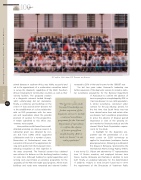
OVI staff in 1998 when D.W. Verwoerd was Director
“The last two years under Verwoerd’s leadership saw further expansion of the diagnostic services to include a national surveillance programme for the National Department of Agriculture to confirm the absence
of bovine spongiform encephalopathy (BSE or ‘mad cow disease’) in our cattle population.”
PART 1
Onderstepoort Veterinary Institute: General History
1908-2008
Years


