


Page 53 - VHSA - Onderstepoort 100 Years - Part 1
P. 53
Health for meat exports to Europe. The residue laboratory successfully participated in a worldwide quality control test coordinated from the UK, confirming that its results meet international standards.
The ARC-OVI was also involved, as OIE Regional Colla- borating Centre for Africa, in organizing
three further workshops aimed mainly at
the SADC countries. These workshops dealt
ONDERSTEPOORT 100
‘Animal Health for Developing Farmers’ was started under the guidance of a programme manager, Mary-Lou Penrith, who had acted as consultant for the FAO on the control of African swine fever in a number of African countries. During the course of these consultancies she took part in various
with the diagnosis of BSE, the control of
rabies and the harmonization of veterinary
drug registration. As a result of these
activities in the fields of rabies control, BSE
surveillance and brucellosis research, the
OVI was approached by the World Health
Organization to act as Collaborating Centre
for emerging and re-emerging zoonoses.
Successful involvement in regional and
international activities also resulted in
the signing of collaboration agreements
with ICIP (International Centre for Insect Physiology) an international research organization in Kenya, and with the National Veterinary Laboratory in Norway.
In order to strengthen the OVI’s ability to provide a service for emerging small-scale farmers a new programme entitled
programmes aimed at determining the needs of small-scale farmers and training them in basic veterinary hygiene and disease recognition.
By outsourcing some of its non-core business activities, such as security and cleaning services, and by implementing voluntary early retirement packages, the OVI managed to reduce its staff by almost a third during 1998. Aided by the substantial research contracts obtained, the target of 30% external income was thereby reached and even exceeded (31%), but at the price of considerably reduced research output.
Nevertheless, the Institute managed to continue making significant scientific contributions during the decade under discussion.
Foremost of these contributions were the advances made in the application of molecular gene technologies in a variety of
“In order to strengthen the OVI’s ability to provide
a service for emerging small-scale farmers a new programme entitled ‘Animal Health for Developing Farmers’ was started ...”
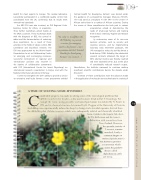
Considerable progress was made in solving some of the toxicological problems that baffled researchers for decades, as discussed in more detail in Part 3: Toxicology. For example the toxin causing gousiekte and named pavetamine was isolated by N. Fourie in 1994 and its chemical structure determined by R. Vleggaar at the University of Pretoria. Geeldikkop was experimentally induced in sheep by dosing crude steroidal saponins, derived from the dubbeltjie plant (Tribulus terrestris), which were subsequently isolated and chemically identified
from crystals in the hepatic bile ducts by T.S. Kellerman and his team in
collaboration with researchers from New Zealand. However,
the sporadic toxicity of T. terrestris remains unsolved. Lastly a
common fungus on maize (Diplodia maydis)
was shown to produce a neurotoxin which
causes the paralytic
disease called diplodiosis in cattle
and sheep.
53
Diversification and change (1980-1998)
1908-2008
Years


