


Page 51 - VHSA - Onderstepoort 100 Years - Part 1
P. 51
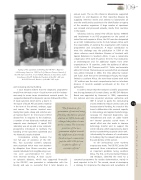
Signing of the agreement establishing the OIE-RCC (Regional Collaborating Centre) in 1993 by Dr J. Blancou, Director-General of the OIE (left), and Dr A.I. van Niekerk, Minister of Agriculture (right). Standing are Dr J.H. Terblanche, President of the ARC (left) and
Dr D. W. Verwoerd, Director of the ARC-O VI (right)
and increasing external funding.
It soon became evident that the diagnostic programme
would form the main source of such income until the Institute was ready to access larger international research grants. An unexpected demand for diagnostic services followed the lifting of trade sanctions which led to a boom in
ONDERSTEPOORT 100
annual event. The six OIE reference laboratories supported research on, and diagnosis of, their respective diseases by supplying reference strains and antisera to laboratories all over the world and by assisting in the identification or typing of the causative organisms. A large number of specimens was received and processed annually, mostly from countries in the region.
Following visits by several FAO officials during 1994/95 and involvement in an FAO programme for the control of tsetse flies and nagana in Africa, the OVI was also designated as an FAO Collaborating Centre for Sub Saharan Africa with the responsibility of assisting the organization with training programmes and consultancies. A major contribution to meet this challenge was the publication in 1994 of the classic reference work Infectious Diseases of Livestock with Special Reference to Southern Africa. It was a remarkable collaborative effort with 37 authors from the four institutions at Onderstepoort and 70 additional experts from other organizations in 16 countries, under the guidance of editors J.A.W. Coetzer, G.R. Thomson and R.C. Tustin, and associate editor N.P.J. Kriek. The book was so successful that an enlarged new edition followed in 2004, this time edited by Coetzer and Tustin, both then at the Onderstepoort Faculty. No longer limited to southern Africa, the new three-volume work with 197 authors was the most comprehensive text on infectious diseases of livestock available world-wide at the time of publication.
In order to ensure that the Institute’s scientific programme met the requirements of its main clients, an ARC-OVI Advisory Board was appointed by Verwoerd in 1996, representing the national and nine provincial veterinary authorities and
the export of South African genetic material in the form of live animals, embryos, eggs and semen. The species involved were mainly Boer goats, sheep and ostriches and all material had to be tested and certified disease-free. In response to the challenge, a number of new diagnostic methods and reagents were developed. A special PCR laboratory was set up and a new computer programme introduced to facilitate the handling of the specimens submitted and the diagnostic results obtained.
“The formation of a government of national unity following the historic general election in 1994 drastically changed the political scene in the country. The economic priorities of the new government shifted towards the upliftment of previously disadvantaged communities and the ARC-OVI did not escape the effects of economic reform.”
OBP. It served to guide the restructuring process needed to reduce running costs and 51 increase external funding. As a result of this forum’s deliberations the research capacity
in immunology and applied biotechnology, necessary for improved diagnostics, was strengthened and work on udder health
and internal parasites scaled down. A
special effort was also made to improve technology transfer and to support the
ostrich industry, which experienced a boom period, by establishing a special ostrich unit. Unfortunately the absence of a mechanism
for funding it by the relevant industry led to
the early demise of this section.
On the international scene excellent progress was made. The OIE-RCC at the OVI sponsored three international workshops on important problems facing southern Africa. The first, on Environmental Pollution and Residues, identified the need for a
Considerable activity marked the
first full year of existence of the OIE-
RCC. Two successful scientific symposia
were organized which were well attended
by delegates from African countries, and
several individuals from neighbouring coun-
tries were accommodated for short-
term informal training. A short course
on epizootic diseases, which was supported financially by the OIE-RCC, was presented in collaboration with the Faculty and was so successful that it later became an
concerted programme for residue determination, mainly in meat exported to the EU. The second, aimed at developing a strategy for improving the diagnosis and surveillance of
Diversification and change (1980-1998)
1908-2008
Years


