


Page 55 - VHSA - Onderstepoort 100 Years - Part 1
P. 55
ONDERSTEPOORT 100 Decline and recovery (1998-2008)
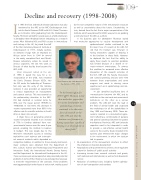
In 1995 the Foot and Mouth Disease Laboratory was also transferred to the ARC as the ARC-Onderstepoort Insti- tute for Exotic Diseases (OIED) with G.R. (Gavin) Thomson as its Director. After graduating from the Onderstepoort Faculty, Thomson worked for several years as a field veterinarian in Zimbabwe (then Rhodesia) before embarking on a research career. After following MSc and PhD courses in immunology and virology in the UK, he joined the staff
of the then Veterinary Research Institute at Onderstepoort in 1977, initially working on diseases of pigs with an emphasis on African swine fever. In 1980 he moved to the newly completed Foot and Mouth Disease Laboratory where he served in various capacities, the last few years as Director of what had by then become the ARC-OIED.
When Verwoerd retired at the end of 1998 it paved the way for a re- incorporation of the OIED, now renamed the Exotic Diseases Division (EDD), into the OVI under the leadership of Thomson. Not only was the unity of the Institute restored, it also provided an opportunity to reduce expenditure on management and support services. This was essential as the parliamentary allocation to the ARC- OVI had declined in nominal terms by 30% over the 4-year period 1995/96 to 1999/2000. In real terms this decrease in income represented more than 60% if the inflation rate for scientific activities in South Africa is taken into account.
by the non-competitive nature of the remuneration structure as well as uncertainties about the future. Uncertainties, in turn, derived from the fact that a major reorganization of the Institute, which was planned for 2000, was put on ice pending a restructuring of the ARC as a whole.
In his business plan for 2000/2001 Thomson stated that molecular approaches to vaccine development and epidemiological studies continued to be the main focus of research at the ARC-OVI and that the Institute was fortunate in having researchers capable of keeping it at the forefront in these fields. However, he deplored the fact that the ability to apply these results to practical problems was limited because of a dearth of re- search-oriented veterinarians. To address this problem he proposed more effective integration of the research activities of the OVI, OBP and the Faculty. Discussions and scenario-planning sessions were held between these organizations and some progress was made in sharing scarce expertise such as in epidemiology and risk-
“In his business plan for 2000/2001 Thomson stated that molecular approaches to vaccine development and epidemiological studies continued to be the main focus of research at the ARC-OVI and that the Institute was fortunate in having researchers capable of keeping it at the forefront in these fields.”
assessment.
He also identified insufficient lines of
communication between the ARC and its institutes on the one hand and government institutions on the other as a serious problem. The ARC-OVI took the lead in the field of animal health and organized two workshops for all the stakeholders in May 1999 and February 2000. These dis- cussions resulted in a documented agree- ment reflecting a commonality of purpose and general consensus between the parties that National, Provincial, ARC and University capacities need to be integrated in order to provide a cost-effective animal health service to the country. Goals included in his business plan reflected the major changes in the environment in which the institute had to operate:
55
A sharp focus on generating external
income fortunately resulted in an increase
of 75% in funding obtained from non-
governmental sources over the same 4-year
period, enabling the Institute to balance
its budget. This was largely due to the
ARC-OVI’s remarkable success in winning
multimillion rand national and internatio-
nal research contracts which depended on
competitive bidding. In addition to those already mentioned, major contracts were obtained from the Department of Arts, Culture, Science and Technology (Lead Programme and Innovation Fund), the International Atomic Energy Agency and the Department for International Development in the UK. These successes were encouraging but also presented potential problems in terms of the infrastruc-ture and expertise necessary to meet the requirements of the contracts. These problems were aggravated by further losses of senior staff, mainly caused
• • •
•
Re-organization of the management structure to reflect the emphasis on business development
Negotiations with government to achieve a more equitable system for funding of ‘public good’ activities
Increasing income from research contracts and grants, both national and international, as well as from diagnostic services
Reduction of overhead costs, including further optimiza- tion of staff composition and numbers
Decline and recovery (1998-2008)
1908-2008
Years


